arXiv preprint 2026
RDDM
RDDM: A Residual-Driven Drifting Model for High-Fidelity Low-Dose CT Denoising
Current or former lab member. Select a name to see all of their projects.
Abstract
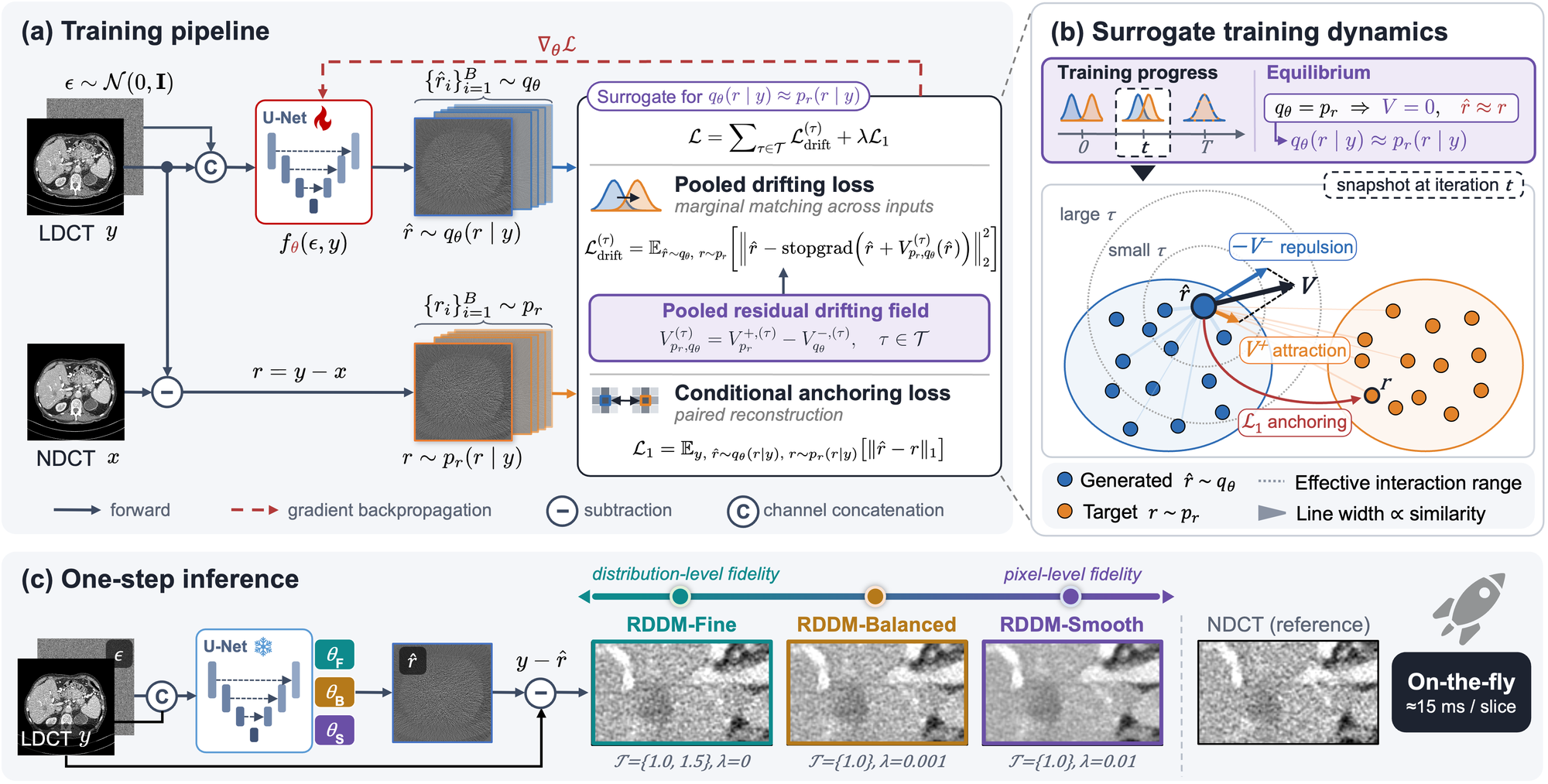
Low-dose CT denoisers trained with conventional reconstruction objectives often produce overly smooth images. Diffusion and flow-based generative models improve fidelity but typically need costly multi-step inference. RDDM (Residual-Driven Drifting Model) extends drifting-based generation to efficient, high-fidelity low-dose CT denoising.
RDDM uses a surrogate training strategy, so that the target residual distribution of each input does not have to be estimated from a single observation. During training, generated and target residuals are pooled separately across inputs to build a drifting field, which aligns the two distributions through attraction toward target residuals and repulsion among generated residuals. A reconstruction loss draws each generated residual toward its observed target and anchors the result to the input. Adjusting the drifting temperature and the anchoring weight controls the trade-off between fidelity to the reference and noise suppression.
At inference, RDDM predicts the residual in a single forward pass. In experiments on two CT datasets it achieves favorable overall denoising performance compared with the evaluated baselines, its three variants balance pixel-level and distributional fidelity while preserving local anatomical structures, and a 512×512 slice is denoised in approximately 15 ms.
What’s in the repository
- The
rddmpackage, installable withpip install rddm - Training scripts for the three variants (Fine, Balanced, Smooth), single-image inference and dataset evaluation
- Links to pretrained weights and instructions for preparing the AAPM Low Dose CT Grand Challenge data
Citation
@article{wang2026rddm,
  title   = {RDDM: A Residual-Driven Drifting Model for High-Fidelity Low-Dose CT Denoising},
  author  = {Wang, Jianxu and Lyu, Qing and Wang, Ge},
  journal = {arXiv preprint arXiv:2605.17188},
  year    = {2026}
}