IEEE Transactions on Medical Imaging 2026
FORCE
Tomographic Foundation Model—FORCE: Flow-Oriented Reconstruction Conditioning Engine
Current or former lab member. Select a name to see all of their projects.
Abstract
Clinical CT scenarios such as low-dose screening, sparse-view scanning and metal implants lead to severe noise and artifacts. Deep learning has advanced CT reconstruction, but paired training data are hard to obtain, and networks trained on approximately paired data carry a risk of hallucination. FORCE (Flow-Oriented Reconstruction Conditioning Engine) integrates data fidelity with a state-of-the-art generative model, the Poisson flow generative model in its generalized form PFGM++.
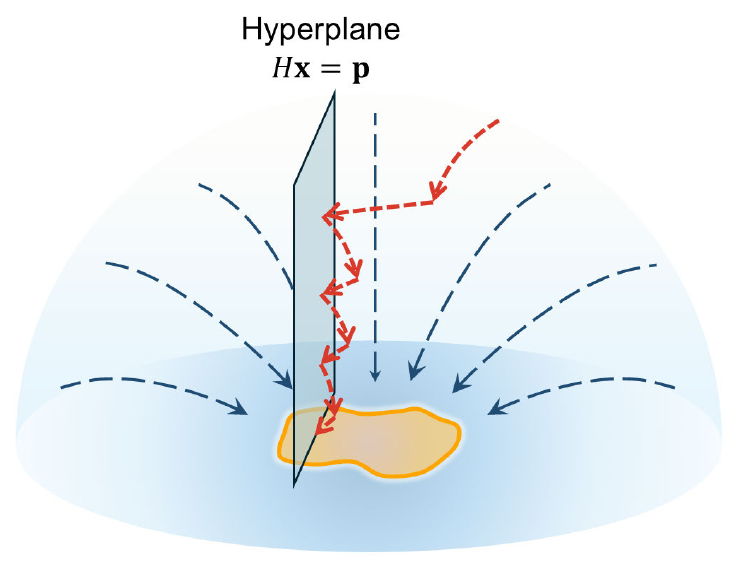
During sampling, the current image estimate is repeatedly corrected by a reconstruction conditioning step built on analytical CT operators, so one generative prior can be conditioned for different CT tasks. In the experiments, FORCE shows superior performance in various CT imaging tasks and outperforms existing unsupervised reconstruction approaches.
What’s in the repository
- Diffusion code based on guided-diffusion, with an EDM/PFGM-compatible sampler and a PFGM++ prior
- CT data-consistency and regularization steps, and the FORCE reconstruction sampler
- Training and sampling scripts, configurations, and notes on checkpoints
Citation
@article{xia2026force,
  title   = {Tomographic Foundation Model—FORCE: Flow-Oriented Reconstruction Conditioning Engine},
  author  = {Xia, Wenjun and Niu, Chuang and Wang, Ge},
  journal = {IEEE Transactions on Medical Imaging},
  volume  = {45},
  number  = {6},
  pages   = {3137--3149},
  year    = {2026},
  doi     = {10.1109/TMI.2026.3669463}
}