Physics in Medicine and Biology 2022
Phase Function Estimation
Phase Function Estimation from a Diffuse Optical Image via Deep Learning
Current or former lab member. Select a name to see all of their projects.
Abstract
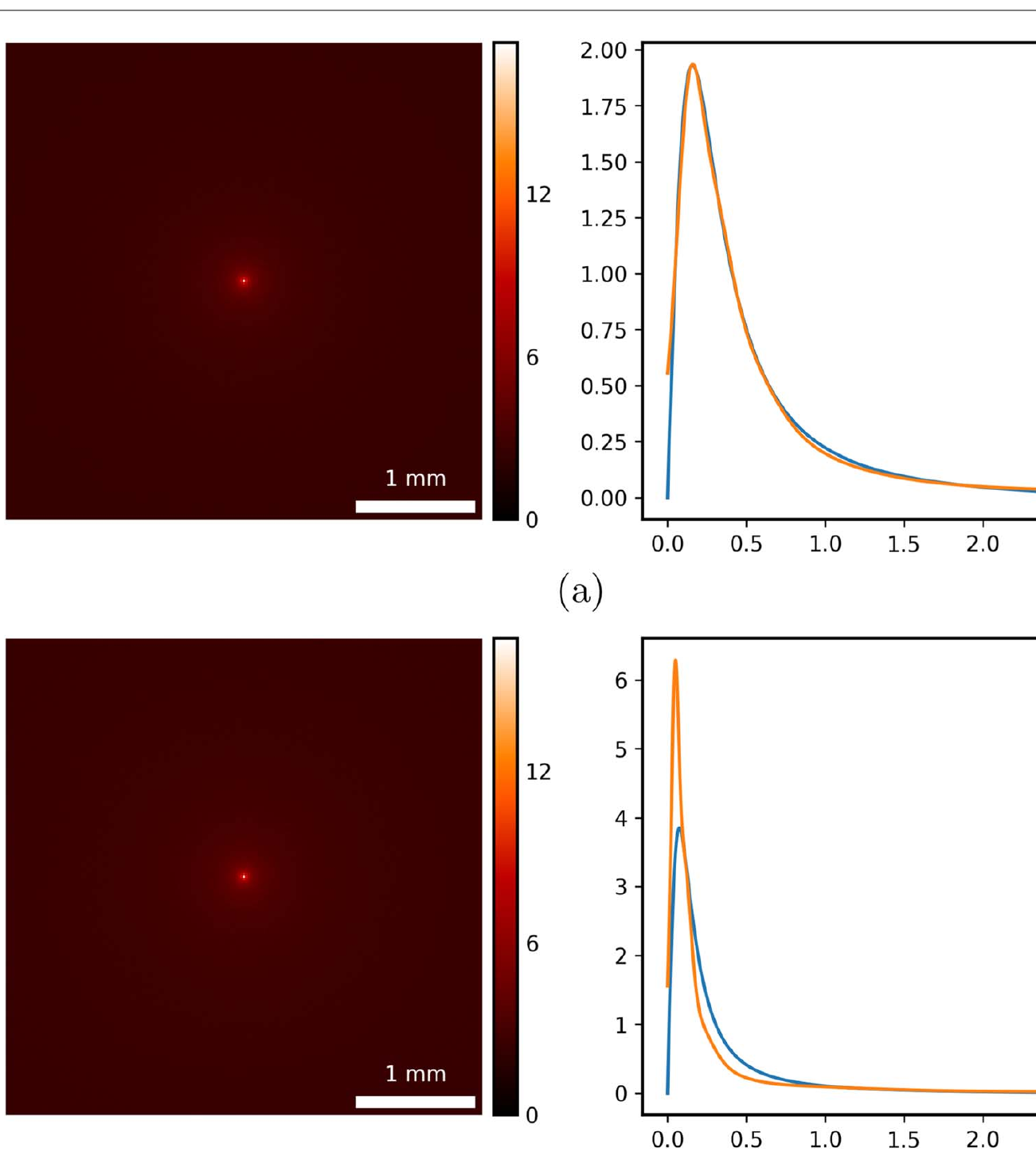
The phase function describes how light is deflected when it scatters in tissue. This work estimates it with a convolutional neural network directly from a diffuse optical image, without assuming a fixed form. A Gaussian mixture model represents the phase function flexibly and still gives an analytic expression for sampling deflection angles in Monte Carlo simulation.
The method was validated on Monte Carlo-simulated reflectance images of typical biological tissues with different anisotropy factors. It reached a mean squared error of 0.01 for the phase function and a relative error of 3.28% for the anisotropy factor. The study also analyzes how field of view and spatial resolution affect the estimate.
What’s in the repository
- A modified CUDAMCML program and scripts that generate the simulated diffuse reflectance data
- Training, cross-validation and testing code
- Scripts that produce the figures, and saved test results
Citation
@article{liang2022phase,
  title   = {Phase Function Estimation from a Diffuse Optical Image via Deep Learning},
  author  = {Liang, Yuxuan and Niu, Chuang and Wei, Chen and Ren, Shenghan and Cong, Wenxiang and Wang, Ge},
  journal = {Physics in Medicine and Biology},
  volume  = {67},
  number  = {7},
  pages   = {074001},
  year    = {2022},
  doi     = {10.1088/1361-6560/ac5b21}
}