Patterns 2022
DNA
Disrupting Adversarial Transferability in Deep Neural Networks
Current or former lab member. Select a name to see all of their projects.
Abstract
An adversarial example crafted for one network often fools another. Earlier explanations pointed to shared adversarial subspaces and correlated decision boundaries, but the mechanism remained largely unclear. This paper argues that transferability comes from a high linear correlation between the features that different models extract, which are related by simple affine transformations between latent spaces.
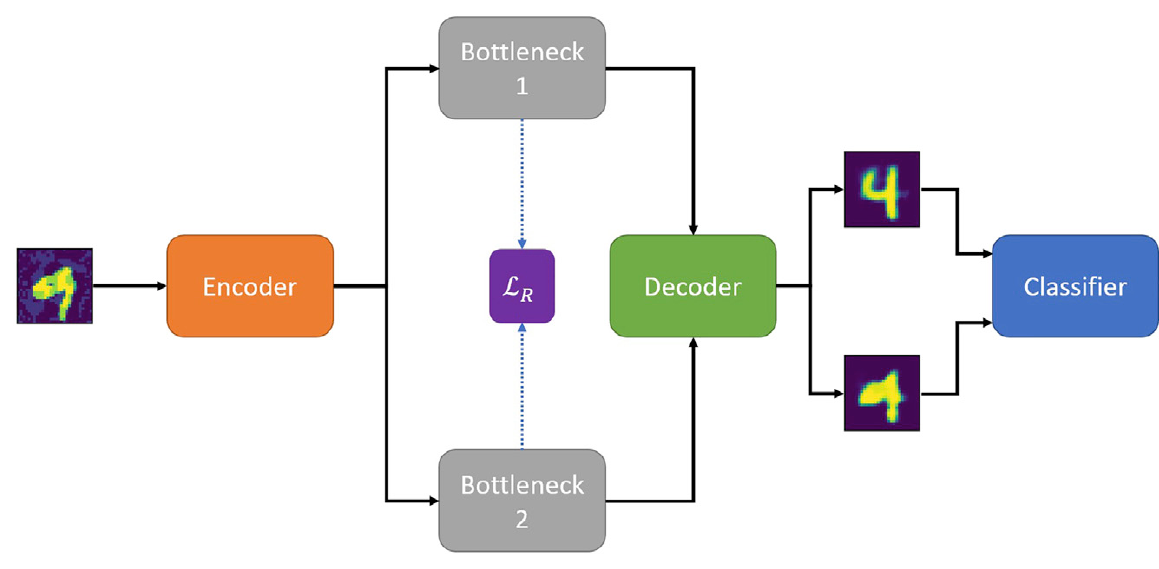
A feature correlation loss reduces this transferability. The paper introduces a dual-neck autoencoder (DNA) that uses the loss to produce two meaningfully different encodings of the same input, with reduced transfer of attacks between them.
What’s in the repository
- Classifier experiments: training of regular and decorrelated models, and attack algorithms
- Notebooks for the CIFAR and MNIST experiments with the DNA and a matching autoencoder
- Trained models for evaluation
Citation
@article{wiedeman2022disrupting,
  title   = {Disrupting Adversarial Transferability in Deep Neural Networks},
  author  = {Wiedeman, Christopher and Wang, Ge},
  journal = {Patterns},
  volume  = {3},
  number  = {5},
  pages   = {100472},
  year    = {2022},
  doi     = {10.1016/j.patter.2022.100472}
}