IEEE Transactions on Image Processing 2022
SPICE
SPICE: Semantic Pseudo-Labeling for Image Clustering
Current or former lab member. Select a name to see all of their projects.
Abstract
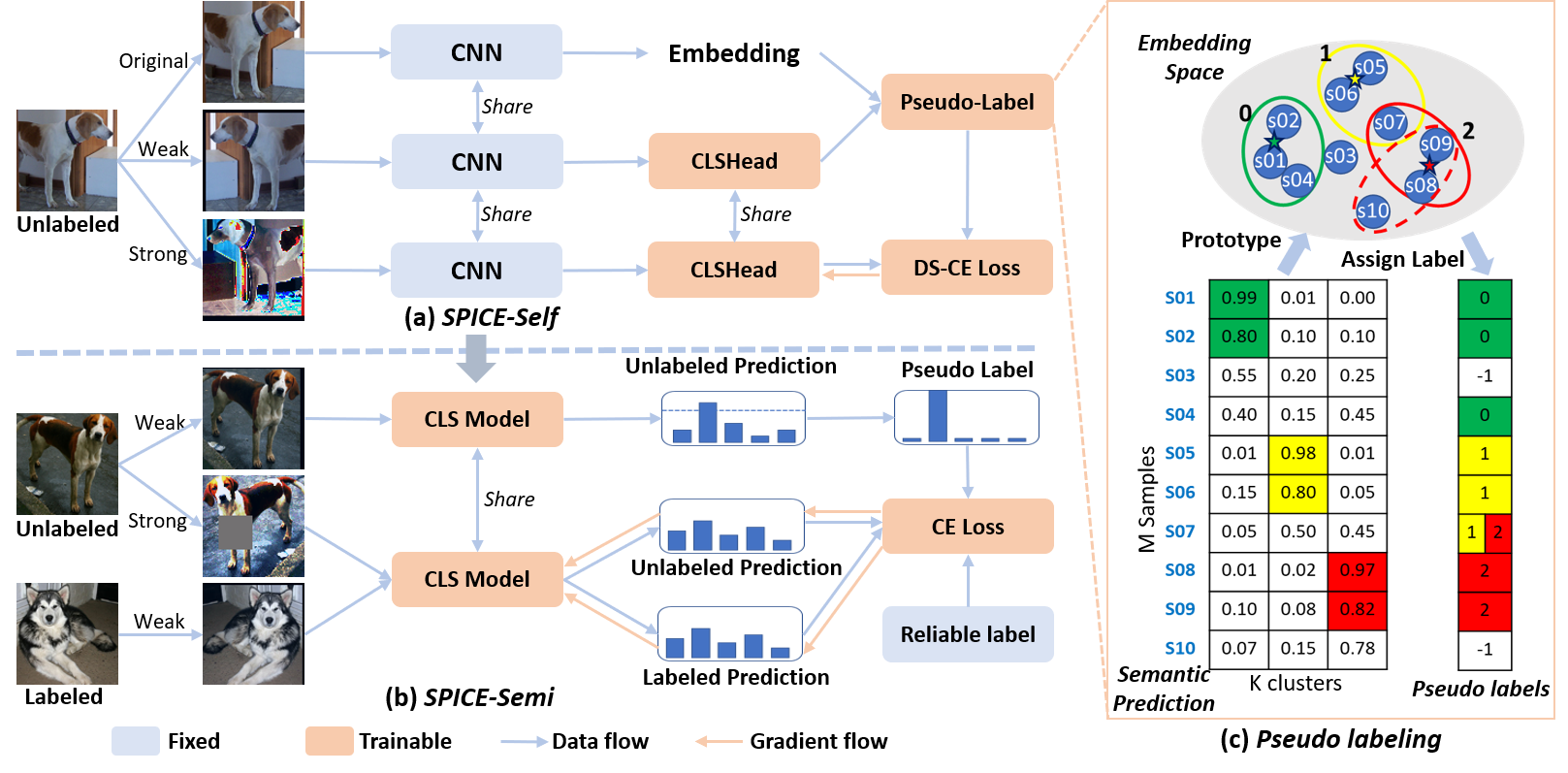
Deep clustering methods often misjudge either the similarity of features or the semantic discrepancy between clusters. SPICE splits the network into a feature model that measures instance-level similarity and a clustering head that captures cluster-level discrepancy. Two semantics-aware algorithms, prototype pseudo-labeling and reliable pseudo-labeling, supply the training signal.
Training has three stages, none of which uses labels: contrastive learning of the feature model, prototype-based training of the clustering head, and joint refinement. SPICE improves on existing methods by about 10% and sets the state of the art on six balanced benchmarks. On CIFAR-10 the unsupervised model reaches 91.8% accuracy, against 93.8% for fully supervised classification.
What’s in the repository
- The SPICE implementation with configurations
- Guides for dataset preparation, training and evaluation
- Bundled MoCo and FixMatch code used in the pipeline
Citation
@article{niu2022spice,
  title   = {SPICE: Semantic Pseudo-Labeling for Image Clustering},
  author  = {Niu, Chuang and Shan, Hongming and Wang, Ge},
  journal = {IEEE Transactions on Image Processing},
  volume  = {31},
  pages   = {7264--7278},
  year    = {2022},
  doi     = {10.1109/TIP.2022.3221290}
}