IEEE Access 2018
pseudo-Randomness
Learning From Pseudo-Randomness With an Artificial Neural Network – Does God Play Pseudo-Dice?
Current or former lab member. Select a name to see all of their projects.
Abstract
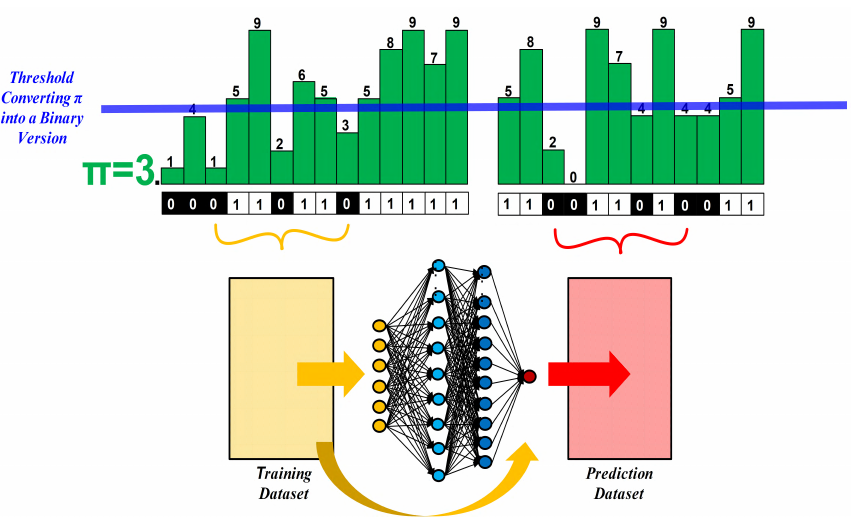
Inspired by the success of neural networks in machine learning, this paper uses them to decode hidden correlations in pseudo-random data and to predict events accordingly. With a simple network structure and a typical training procedure, the network learns and predicts in pseudo-random environments.
The authors suggest that the sensitivity and efficiency of neural networks may allow learning on a low-dimensional manifold inside a high-dimensional space of pseudo-random events, and that this offers a way to probe whether quantum randomness and pseudo-randomness differ fundamentally.
What’s in the repository
- MATLAB training scripts
- Digit sequences of π and e, and recorded results
Citation
@article{fan2018learning,
  title   = {Learning From Pseudo-Randomness With an Artificial Neural Network – Does God Play Pseudo-Dice?},
  author  = {Fan, Fenglei and Wang, Ge},
  journal = {IEEE Access},
  volume  = {6},
  pages   = {22987--22992},
  year    = {2018},
  doi     = {10.1109/ACCESS.2018.2826448}
}